- Dr Bart's Newsletter
- Posts
- Why Your Roadmap Planning Feels Like a Waste of Time (And How to Fix It)
Why Your Roadmap Planning Feels Like a Waste of Time (And How to Fix It)
Ten principles for turning your planning process from a bureaucratic ritual into a genuine strategic tool

Bartosz Jaworski
April 17, 2026
Most Product Managers have a complicated relationship with roadmap planning.
In theory, it is one of the most important things you do. It is the moment when strategy becomes executable, when competing priorities get resolved, and when the team gets a shared picture of where the product is going and why. Done well, it creates alignment, builds confidence across the organisation, and gives you a defensible basis for every resourcing conversation you will have for the next twelve months.
In practice, it often feels like none of those things. It feels like a sequence of meetings that produce a document that is already out of date by the time it is shared, that satisfies nobody completely, and that will need to be substantially revised within six weeks anyway. It feels, in other words, like a counterproductive waste of time.
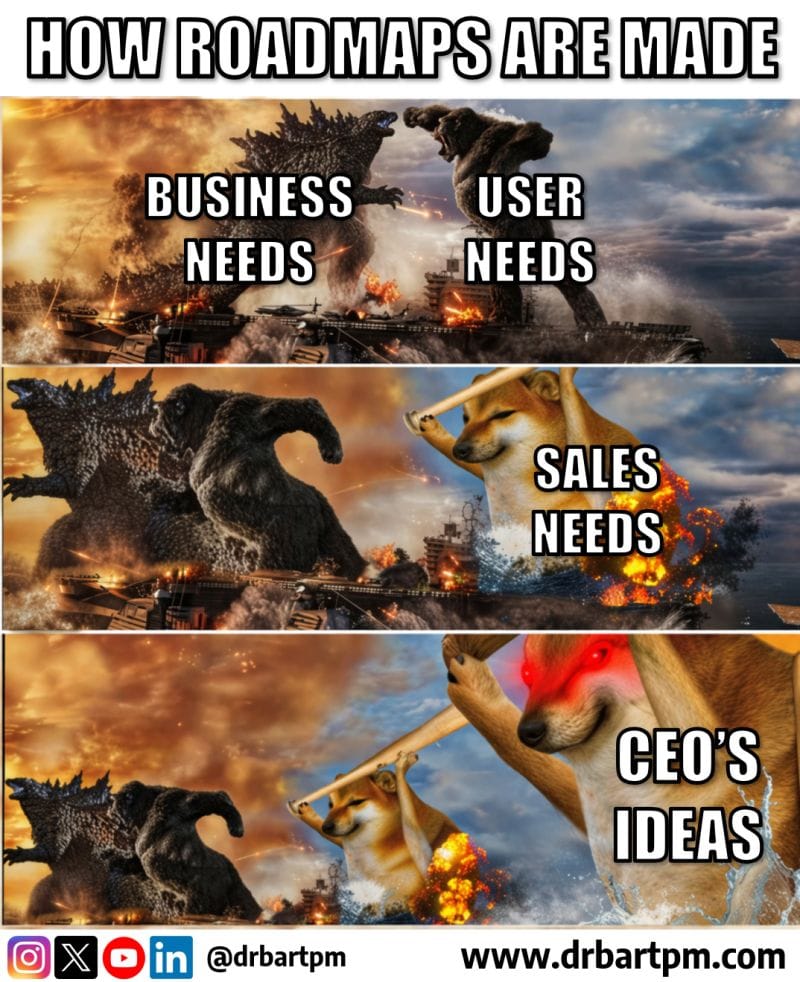
The problem is rarely the concept of a roadmap. The problem is almost always the process by which the roadmap is built. Today, I want to examine that process in detail, because the ten principles I am going to walk through are not just tips for making planning more efficient. They are fundamentally different ways of thinking about what a roadmap is and what it is supposed to do.
Let us dive in.
The Underlying Problem
Before we get into the specifics, it is worth naming the failure mode that most roadmap processes share.
The typical roadmap planning cycle is reactive and compressed. It begins too late, usually when someone senior realises that the new year is approaching and there is no plan in place. It is driven by whoever shouts loudest in the planning meeting rather than by a structured process for evaluating competing priorities. It produces a document that looks like a commitment but was never genuinely agreed upon by the people responsible for delivering it. And it is communicated in a way that creates exactly the wrong expectations.
The result is a roadmap that nobody fully trusts, that creates friction rather than alignment, and that the team privately views as a political document rather than a genuine guide to what they are building.
What follows is how to build something better.
PROMO SEGMENT (but please do read)
Stop cold applying.
AI doesn't just speed up your job search. It runs it. The candidates landing PM offers are using AI to find the right people, write the right outreach, and turn cold contacts into warm referrals before you've finished updating your resume. This masterclass shows you the exact system: how AI replaces the cold application grind and gets you in front of hiring managers faster. Cohort 3 starts May 4, 2026. This is your preview.

1. Start Earlier Than Feels Necessary
The single most reliable predictor of a smooth planning cycle is how early it begins.
If you start your annual roadmap planning in January, you are already late. If you start in December, you are very late. October, which feels absurdly early to most PMs who have not tried it, is actually about right for organisations that want their planning to be genuinely consultative rather than rushed.
The reason is simple. A roadmap that is worth having requires input from multiple stakeholders, legal review, design exploration, and engineering estimation. Each of those steps takes time, and each of them produces feedback that needs to be incorporated before the next step can happen meaningfully. When planning starts late, those steps get compressed or skipped, and the resulting roadmap reflects that compression.
Starting early also changes the emotional register of the process. A planning cycle that begins in October with a loose draft and several weeks of refinement ahead of it is a creative, collaborative exercise. A planning cycle that begins in December with a board presentation scheduled for January is a stressful race against a deadline, which produces very different outputs.
Key Principle: The quality of your roadmap is largely determined before the planning meetings begin. Starting early is not about being organised for its own sake; it is about creating the conditions under which good thinking can happen. |
2. Anchor Everything to Strategy
A roadmap without a clear strategic foundation is, as I have said before, a wish list. It is a collection of things people want to build, ordered by some combination of urgency, seniority, and whoever made the most compelling argument in the last planning meeting.
Before a single initiative goes onto a candidate roadmap, the strategic context needs to be explicit and shared. What are the business goals for the period this roadmap covers? What are the most important customer problems that the product needs to address? Where is the product in its lifecycle, and what does that imply about the right balance between growth, retention, and infrastructure investment?
These are not rhetorical questions. They need written, agreed-upon answers, because the roadmap is the mechanism by which strategy becomes action. Every initiative on it should be traceable back to a specific strategic objective. If an item cannot be connected to the strategy in a clear and direct way, that is not necessarily a reason to reject it, but it is a reason to examine it carefully before including it.
This discipline also gives you something invaluable when you need to say no: a principled basis for the decision that goes beyond personal preference or political expediency.
3. Build the Roadmap With the Organisation, Not For It
One of the most common and most costly mistakes in roadmap planning is treating it as a product management exercise that is then presented to the rest of the organisation for approval.
The people who need to implement the roadmap, and who need to trust it enough to plan their own work around it, should be meaningfully involved in creating it. This means involving engineering in the early stages, not just for estimation but for identification of technical investment needs that the PM may not be aware of. It means involving sales and customer success, who have direct and daily exposure to the customer pain points that the roadmap should be addressing. It means involving support, who hear the complaints that do not always make it into formal research.
Each of these groups brings a perspective that the PM does not have, and each of them is more likely to support and work within a roadmap that they helped shape than one that arrived in their inbox as a finished document.
This does not mean that the roadmap is designed by committee, or that every suggestion from every stakeholder must be incorporated. The PM's job is to integrate diverse inputs into a coherent plan, which requires editorial judgment. But the inputs need to be genuinely sought and genuinely considered.
4. Do Not Skip the Legal Review
This principle tends to get eye-rolls from PMs who have not yet been burned by skipping it.
Legal and compliance requirements have a habit of appearing late in a delivery cycle and requiring changes that are significantly more expensive than they would have been if identified at the planning stage. In regulated industries, this is an obvious concern: a fintech product that does not account for payment regulation, a health product that has not considered data protection requirements, a consumer app that needs to comply with accessibility legislation. But it applies more broadly than many PMs assume.
A brief legal review at the roadmap stage, when it costs nothing beyond a conversation and a few days of waiting time, is worth substantially more than a legal review at the delivery stage, when it costs rework, delays, and in the worst cases, the ability to ship at all.
Build this into your planning process as a standard step rather than an optional one. The times when it catches nothing will be invisible. The one time it catches something significant will more than justify every earlier review.
5. Use a Workshop to Surface What You Would Not Have Found Alone
There is a limit to what any individual, however experienced and well-informed, can identify through solo analysis. Good ideas exist in places you have not looked. Problems exist that have not been escalated to you. Connections between initiatives that seem unrelated are visible to people closer to the work than you are.
A well-facilitated brainstorming workshop, early in the planning cycle, is one of the most reliable ways to surface this distributed knowledge. The keyword is well-facilitated. A workshop that is simply a meeting in which people share opinions tends to be dominated by the most senior or most vocal participants, which defeats the purpose. A workshop that uses structured creative techniques, whether that means physical sticky notes, digital collaboration tools, or timed individual thinking followed by group synthesis, creates conditions in which quieter voices contribute and unexpected ideas emerge.
The output of a workshop is not a finished roadmap. It is a richer and more representative pool of candidate ideas than you would have generated alone, which is exactly what the next stages of the planning process require.
6. Estimate Effort Before You Prioritise
Prioritisation that considers impact without considering effort is not really prioritisation. It is wishful thinking.
The instinct to prioritise by impact alone is understandable. High-impact initiatives feel like they deserve to be at the top of the list regardless of what they cost. But an initiative that delivers high impact at high cost and long timeline may well be less valuable to the roadmap than an initiative that delivers moderate impact at low cost and short timeline, because the second initiative frees up capacity for additional work and creates visible progress that builds confidence across the organisation.
Before you begin the formal prioritisation process, work with engineering to produce rough effort estimates for the most promising candidate initiatives. These do not need to be precise; order-of-magnitude estimates that distinguish between small, medium, and large initiatives are sufficient at the planning stage. The goal is to give the prioritisation conversation a realistic foundation, so that the resulting roadmap reflects not just what the team wants to build but what they can actually deliver.
Ask yourself: "Does my current prioritisation process account for what initiatives will actually cost, or am I selecting based on aspiration and then hoping the capacity works out?" The answer will tell you whether your roadmap is a plan or a list. |
7. Make the Vision Visible
Product roadmaps are, by necessity, largely textual documents. They contain descriptions, objectives, metrics, and timelines. And for the people who created them, who lived through the discussions and decisions that shaped each line, those descriptions are rich with meaning.
For everyone else, they often are not.
A simple visual representation of a key initiative, a rough wireframe, a user journey sketch, or a concept mock-up can communicate in seconds what a paragraph of description communicates in minutes, and it communicates it in a way that is much less susceptible to misinterpretation. When stakeholders can see, even approximately, what a proposed initiative will look and feel like for a user, their feedback becomes more concrete and more useful. Their alignment becomes more genuine because they are aligning on something they have actually understood, rather than something they have read and mentally translated in their own way.
This does not require polished design work. A quick sketch from a designer, produced early in the planning process when changes are cheap, is more than sufficient. The investment is small. The return in reduced misalignment and rework is typically significant.
8. Plan in Quarters, Not Months or Sprints
The unit of time you use for roadmap planning shapes the character of the conversations you have about it.
Sprint-level roadmaps are operational documents. They answer the question of what the team will build in the next two weeks, which is a legitimate question, but not a strategic one. A roadmap built at sprint granularity is too detailed and too rigid for strategic planning purposes; it collapses under the weight of the inevitable changes that occur over any meaningful timeframe.
Monthly roadmaps are marginally better but still suffer from a precision problem. Monthly commitments create an expectation of delivery that is difficult to honour when the work involves genuine uncertainty, which almost all meaningful product work does.
Quarterly planning sits at the right level of abstraction for a strategic roadmap. A quarter is long enough to contain meaningful work and short enough to plan with reasonable confidence. It communicates direction and priority without creating false precision about timing. And it gives the team enough room to absorb the unexpected challenges and opportunities that will inevitably arise, without requiring the roadmap to be rebuilt from scratch every time something changes.
9. Leave Room to Breathe
No roadmap that fills 100% of available capacity will be delivered as planned. This is not a pessimistic prediction; it is a near-universal empirical observation across product teams.
Unexpected technical complexity will emerge. Priorities will shift in response to market changes or executive decisions. People will be sick, or will leave, or will be pulled onto urgent work that was not on anyone's roadmap three months ago. External dependencies will slip.
A roadmap that accounts for none of this is not ambitious; it is brittle. It will break at the first significant disruption, and every subsequent disruption will require a replanning exercise that consumes exactly the kind of time and attention that should be going into delivery.
Leaving 20 to 30 percent of quarterly capacity unplanned is not slack. It is the buffer that allows the team to absorb disruption without derailing, to take advantage of unexpected opportunities without abandoning existing commitments, and to do the unglamorous maintenance and improvement work that never makes it onto roadmaps but is essential to the long-term health of the product.
10. Communicate What the Roadmap Actually Is
This is the principle that determines whether all the work above creates alignment or disappointment, and it is the one most frequently handled badly.
A roadmap is a statement of current intent based on current information. It is not a contract. It is not a commitment. It is not a guarantee of what will be delivered and when. It is the team's best current thinking about what to build next, given what is known today, with the explicit understanding that what is known will change.
This needs to be communicated clearly and repeatedly, because the natural human tendency when receiving a document that describes future plans is to treat it as a promise. Stakeholders will share the roadmap with their teams, their customers, and their leadership as evidence of what is coming. When plans change, they will feel misled, not because they were deliberately deceived, but because the nature of the document was not established clearly enough at the outset.
The best roadmap communication explicitly distinguishes between different levels of confidence: initiatives that are firmly committed for the current quarter, initiatives that are planned for subsequent quarters but subject to revision, and longer-horizon ideas that represent direction without implying commitment. This distinction manages expectations accurately, which is always better than managing them optimistically.
The Bigger Picture: What a Roadmap Is Really For
The point of a roadmap is not the document. The document is a by-product.
The point is the process of building shared understanding across an organisation about what the product is trying to achieve, why those priorities were chosen over others, and what the team will need to execute well. A roadmap that was built through a genuine collaborative process, that is anchored in strategy and customer evidence, and that has been communicated with appropriate honesty about its certainty, creates alignment that sustains the team through the inevitable disruptions and pivots ahead.
A roadmap that was built quickly, by a small group, and communicated as a commitment creates the opposite: false certainty that turns into disappointment, and a planning process that everyone dreads next year.
The ten principles above are, at their core, an argument for treating roadmap planning as an investment rather than a tax. The upfront effort is real. The return, in reduced friction, stronger alignment, and a team that actually trusts the plan it is working against, is considerably more real.
"A roadmap is not a promise about the future. It is a record of your best current thinking about how to create value, held lightly enough to change when better thinking emerges." |
A question worth sitting with: when your team looks at the current roadmap, do they feel guided by it, or constrained by it?
The answer will tell you most of what you need to know about whether the planning process is working.